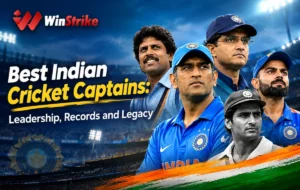
Best Indian Cricket Captains: Leadership, Records and Legacy
Leadership changed Indian cricket
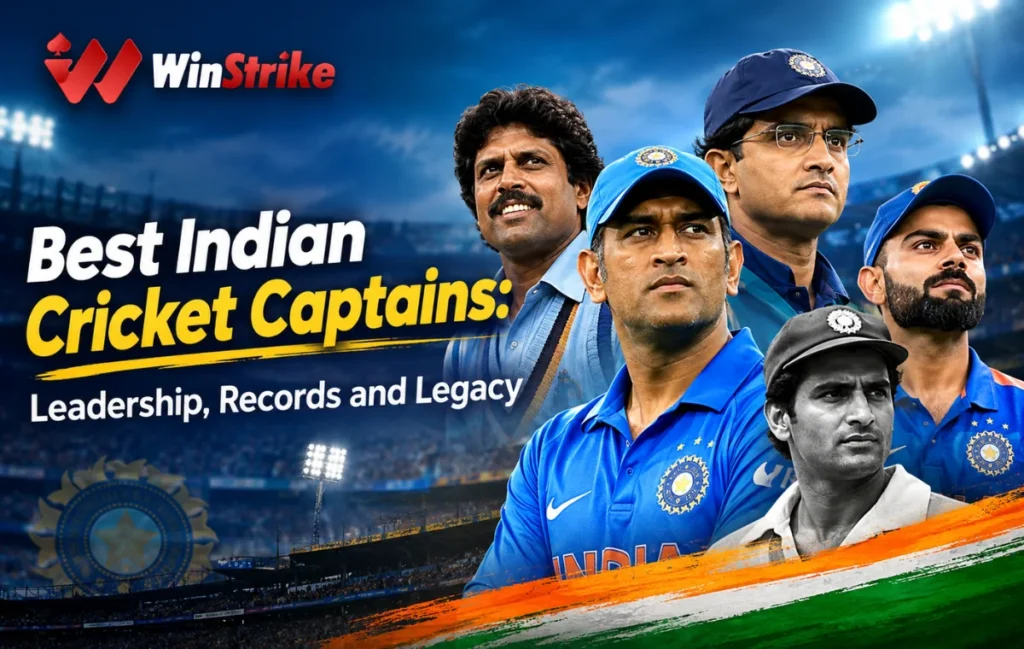
Indian cricket once saw an overseas draw as a result worth taking. Since then, the side has grown into a regular contender in major events. Talent drove part of the rise. Yet captains changed the dressing room first.
They chose players, set field plans, and fixed the mood after bad days. Therefore, the best Indian cricket captains changed how the team thought about pressure. Ganguly asked for a fight. Then Dhoni made calm a habit. Kohli made fitness a duty. Rohit has put trust and firm roles at the center.
For Winstrike readers, this line of leaders explains why Indian teams now enter big events with fewer doubts.
How did Sourav Ganguly rebuild the Indian team?
When Ganguly took charge in 2000, match fixing had damaged the team’s standing. At the start, he had to restore trust inside the group. So he backed young players who attacked.
Virender Sehwag moved from middle order to opener. Yuvraj Singh got time to settle. Zaheer Khan learned through long spells. Ganguly kept faith in Harbhajan Singh, who took 32 wickets in three Tests against Australia in 2001.
In addition, Ganguly also desired India to be tough in foreign lands. India won at Headingley in 2002, entered the final of 2002 Champions Trophy and also the final of 2003 World Cup. The most important contribution from Ganguly was his team’s mentality.
Still, overseas series wins stayed rare. His teams no longer accepted a passive role against leading sides. That shift stayed with India long after Ganguly left the job.
MS Dhoni captaincy and control in finals
MS Dhoni captaincy rested on clear calls at tense moments. At the start, he gave bowlers simple plans. Then he backed them when a change looked tempting.
In the match against Pakistan held in Johannesburg in 2007, he went ahead and selected Joginder Sharma for his team’s last over. India managed to win the first-ever T20 World Cup under one of the leading T20I captains of India. Further on in 2011 ODI World Cup final against Sri Lanka, Dhoni got himself to No. 5.
India won the Champions Trophy over England in Birmingham two years later. No other captain among the ODI captains of India has won the three major white ball tournaments.
Key records from his captaincy include:
- ODI wins: 110
- T20I wins: 41
- Test wins: 27
- T20 World Cup: 2007
- ODI World Cup: 2011
- Champions Trophy: 2013
MS Dhoni captaincy also drew on his wicket-keeping view. So he moved fielders late, turned to part time spin, and kept the group steady after a bad session. His title record places MS Dhoni captaincy at the center of any account of the best Indian cricket captains.
For Winstrike followers, his patience with players and plans offers the main lesson.
Virat Kohli captaincy made Tests central
Virat Kohli captaincy put Test cricket at the heart of the team plan. So India aimed for 20 wickets, even on flat grounds, and chased wins away from home.
For this reason, Kohli raised fitness demands across the group. Then he backed a pace attack with real depth. Mohammed Shami, Ishant Sharma, Jasprit Bumrah, Umesh Yadav, and Mohammed Siraj drove the change. He also made fielding a key part of selection.
India won 40 of 68 Tests under Kohli. It held the No. 1 Test rank for 42 straight months. Also, India won its first Test series in Australia in 2018 and 2019 by 2 to 1.
At home, his teams won 11 straight Test series. Away from home, wins in England, South Africa, and Australia showed the pace unit had range. Virat Kohli captaincy favoured five bowlers when the match needed wickets.
At Winstrike, readers studying the best Indian cricket captains will find Kohli’s mark in this attack. Team choices drew debate at times. Still, the test results changed the standard for every captain who followed.
Rohit Sharma: Roles and major titles
Rohit Sharma is very laid back with the media, though his decisions have often been firm. It is because of that he has also asked his senior batsmen to change their approach for the team. This was evident from the way he has batted in the 2023 ODI World Cup.
Then Rohit led India through the 2024 T20 World Cup without a defeat. India later won the 2025 Champions Trophy under him.
Key records from his captaincy include:
- ODI wins: 42 from 56 matches
- T20I wins: 49 from 62 matches
- ODI win rate: 75 percent
- T20I win rate: 79 percent
- 2024: T20 World Cup title
- 2025: Champions Trophy title
For the Winstrike audience, his value comes from steady talks and fixed roles. Bowlers know their phases. Batters know when risk fits the plan.
The Captaincy Record
Kapil Dev sits in this group because the 1983 World Cup win altered India’s aims. India beat West Indies in the Lord’s final after beating England in the semi final. Earlier, Kapil’s 175 against Zimbabwe kept the campaign alive.
To give a quick recap, captaincy wins until March 2025 are as follows:
| Captain | Test Wins | ODI Wins | T20I Wins |
| Sourav Ganguly | 21 | 76 | 0 |
| MS Dhoni | 27 | 110 | 41 |
| Virat Kohli | 40 | 65 | 30 |
| Rohit Sharma | 12 | 42 | 49 |
Numbers set the record. The legacy also rests in the habits each captain left behind.
What do these captains tell us?
Sourav Ganguly restored belief in the team after a difficult period. He backed young players and pushed India to play with more confidence overseas. His leadership helped create a stronger team culture.
Dhoni brought calm to high-pressure games and delivered major white ball titles. Kohli raised fitness standards and built a strong pace attack for Test cricket. Rohit has continued that progress by giving players clear roles and leading India to major white ball titles.
The best Indian cricket captains shaped more than match results. Their decisions changed how India approached pressure, selection, fitness, and big tournaments. Each captain left a distinct influence on the team that followed.